
What to Look for When Choosing a Wound Care Billing Partner

Updated: Sep 21
Healthcare providers specializing in wound care face unique financial and operational challenges, from managing complex documentation requirements to navigating constantly changing payer policies. Maintaining a healthy revenue cycle requires more than standard medical billing expertise.
That's why choosing the right wound care billing partner is one of the most important business decisions your practice can make.
A specialized billing company can help improve claim accuracy, reduce denials, accelerate reimbursements, and ensure compliance with Medicare, Medicaid, and commercial insurance requirements. More importantly, it allows physicians and clinical staff to focus on delivering exceptional patient care rather than spending valuable time resolving billing issues.
In this guide, we will discuss the most important factors to consider when selecting a wound care billing partner and explain how the right billing team can support a stronger financial and operational performance for your practice.
Why Specialized Wound Care Billing Matters
Unlike many medical specialties, wound care involves highly specific procedures and documentation standards where billers use specific codes for each case.
Billing often includes:
Wound Debridement procedures
Negative Pressure Wound Therapy
UltraMIST Therapy
Each service comes with its own coding guidelines, medical necessity requirements, and payer-specific coverage policies.
Even small documentation or coding errors can contribute to payment delays, claim denials, audits, or missed revenue. That is why it is important to choose a wound care billing company with experience navigating Medicare and other payer requirements.
At Core Medical Billing Inc., our specialists help practices understand how documentation, coding, medical necessity, and payer policies connect across the revenue cycle.
A billing partner with wound care expertise understands these complexities and helps ensure claims are submitted the first time accurately, before they create larger challenges.
1. Look for Proven Wound Care Experience
Medical billing companies often advertise that they serve "all specialties." While this may sound appealing, wound care is a niche field that requires specialized knowledge.
Ask a potential billing vendor:
How many wound care practices do you currently support?
How long have you worked with wound care providers?
Do your coders have experience with wound care procedures?
Can you provide references or case studies?
Experience matters because billing teams familiar with wound care understand the documentation and coding details payers may review before determining coverage and payment.

2. Expertise in CPT, ICD-10, and HCPCS Coding
Accurate coding is the foundation of successful medical billing.
Your billing partner should stay current with:
CPT codes
ICD-10 diagnosis codes
HCPCS codes
National Correct Coding Initiative (NCCI) edits
Medicare Local Coverage Determinations (LCDs)
Commercial payer policies
Incorrect coding doesn't just delay payment—it can expose your practice to compliance risks and potential audits.
Certified coders with wound care experience help maximize reimbursement while maintaining regulatory compliance.
3. Strong Understanding of Medicare Policies
Many wound care patients are Medicare beneficiaries.
Because Medicare frequently updates coverage criteria, your billing partner should continuously monitor changes affecting:
Debridement frequency
Skin substitute utilization
Documentation requirements
Medical necessity standards
A knowledgeable billing company proactively adapts billing workflows as regulations evolve.
4. Comprehensive Insurance Verification
Revenue cycle success starts long before a claim is submitted.
An effective billing partner verifies:
Patient eligibility
Active insurance coverage
Deductibles
Copays
Coinsurance
Prior authorization requirements
Verifying eligibility and benefits before treatment can help reduce billing surprises for patients and identify coverage or authorization issues that may contribute to claim denials.
5. Efficient Prior Authorization Management
Certain wound care treatments require prior authorization before services can be performed.
When required authorization is missing or incomplete, a payer may deny or delay the claim.
An experienced billing company should manage:
Authorization requests
Supporting documentation
Communication with payers
Authorization tracking
Renewal requests when necessary
A structured process can help reduce avoidable administrative delays and support timely reimbursement to protect your revenue.
6. Effective Denial Management
Even well-run practices experience denied claims.
The difference lies in how quickly and effectively those denials are resolved.
Ask prospective billing companies about their denial management process.
Strong partners should:
Analyze denial trends
Correct coding issues
Submit appeals promptly
Track appeal outcomes
Recommend workflow improvements
Reducing recurring denials improves long-term financial performance.
7. Transparent Revenue Cycle Reporting
Data-driven decision-making is essential for modern medical practices.
Your billing partner should provide detailed reports covering:
Net collections
Gross collections
Accounts receivable aging
First-pass claim acceptance rate
Days in Accounts Receivable (A/R)
Denial percentage
Payment turnaround times
These insights help practice owners monitor financial health and identify opportunities for improvement.
8. Seamless EMR/EHR and Practice Management Integration
Technology plays a major role in efficient billing operations.
Look for billing partners that integrate with your existing:
Electronic Health Record (EHR)
Practice Management (PM) software
Clearinghouse
Scheduling platform
Patient payment systems
Integrated workflows help reduce duplicate data entry, improve claim accuracy, and help accelerate reimbursement.
9. HIPAA Compliance and Data Security
Medical billing companies handle sensitive patient information every day.
Before choosing a partner, confirm they maintain:
HIPAA-compliant systems
Secure encrypted communication
Role-based data access
Regular security training
Disaster recovery procedures
Business Associate Agreement (BAA)
Protecting patient information is just as important as collecting payments.
10. Dedicated Account Management
Outstanding customer service makes a significant difference.
Rather than contacting a different representative every time you have a question, choose a company that assigns a dedicated account manager.
This provides:
Faster issue resolution
Personalized support
Regular performance reviews
Better communication
Consistent follow-through
Stronger long-term partnership
11. Scalable Billing Services
Your practice may grow over time by adding:
New providers
Additional clinic locations
Advanced wound care services
Higher patient volume
Your billing partner should be able to grow with you without sacrificing service quality.
Scalable billing infrastructure prevents disruptions during expansion.
12. Revenue Optimization Rather Than Simple Claim Submission
The best billing companies function as strategic partners.
Instead of simply processing claims, they actively look for ways to improve your revenue cycle by:
Identifying undercoded services
Reviewing provider documentation
Improving workflow efficiency
Monitoring payer performance
Reducing billing bottlenecks
Their goal should be to maximize your practice’s financial performance while keeping compliance at the center of every revenue cycle decision.

Questions to Ask Before Hiring a Wound Care Billing Company
Before making your decision, consider asking:
How much experience do you have with wound care practices?
What is your average claim acceptance rate?
How do you manage denied claims?
Do you have 24/7 billing services?
How often will we receive financial reports?
Do you provide coding assistance?
How do you stay updated on Medicare policy changes?
Do you provide training and support?
How do you ensure HIPAA compliance?
The answers will help you compare vendors beyond pricing alone.
Potential Red Flags to Consider:
Not every billing company is equipped to handle the complexities of wound care.
Be cautious if a billing vendor:
Has little or no wound care experience
Cannot explain its denial management process
Offers limited reporting capabilities
Has poor communication or slow response times
Makes unrealistic promises, such as guaranteeing 100% claim approval
Is not transparent about fees or contract terms
Choosing a vendor without the right experience, controls, or transparency may contribute to denials, compliance concerns, and missed revenue opportunities.
The Bottom Line
Selecting the right wound care billing partner is about more than outsourcing administrative work - it's about building a long-term relationship that supports your practice's financial success.
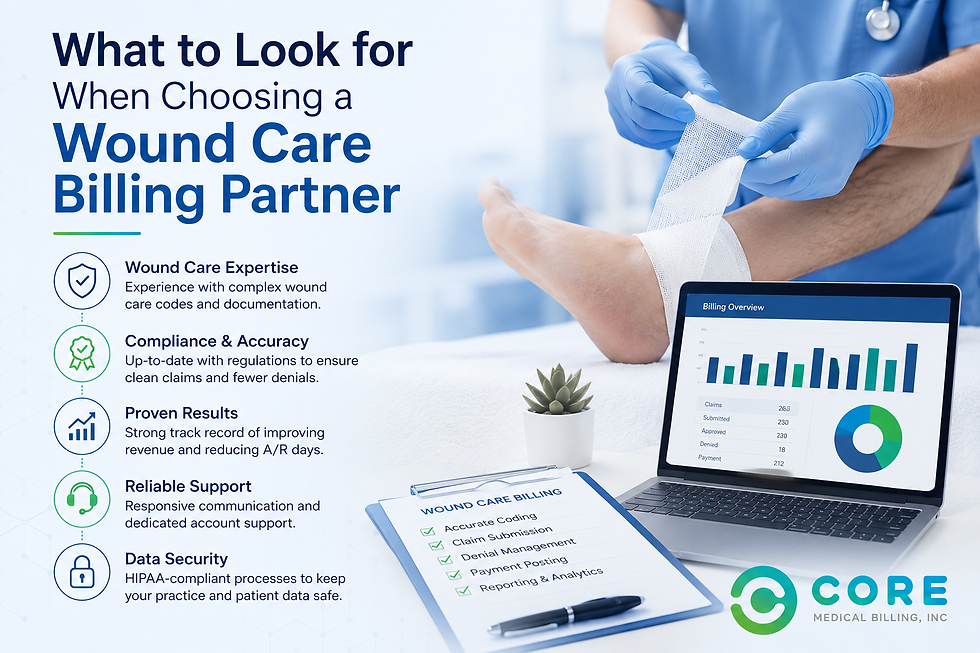
A qualified billing company should bring specialized wound care expertise, accurate coding, proactive denial management, transparent reporting, strong compliance practices, and outstanding customer support.
When billing is handled efficiently, providers can spend less time worrying about reimbursement and more time delivering exceptional care to patients and focus on the future of building a strong practice.
Investing in the right billing partner today can lead to healthier cash flow, fewer claim denials, improved operational efficiency, and sustainable growth for your wound care practice.
Frequently Asked Questions (FAQ)
Why is wound care billing different from general medical billing?
Wound care billing involves specialized procedures, strict documentation requirements, complex coding, and frequently changing payer policies. These factors require expertise beyond standard medical billing.
How can a specialized billing partner improve revenue?
An experienced billing partner helps reduce coding errors, minimize claim denials, optimize reimbursement, improve documentation, and accelerate payment collection.
Is outsourcing wound care billing cost-effective?
For many practices, outsourcing reduces administrative burden, lowers staffing costs, improves claim accuracy, and increases collections—often resulting in a stronger overall return on investment.


Comments